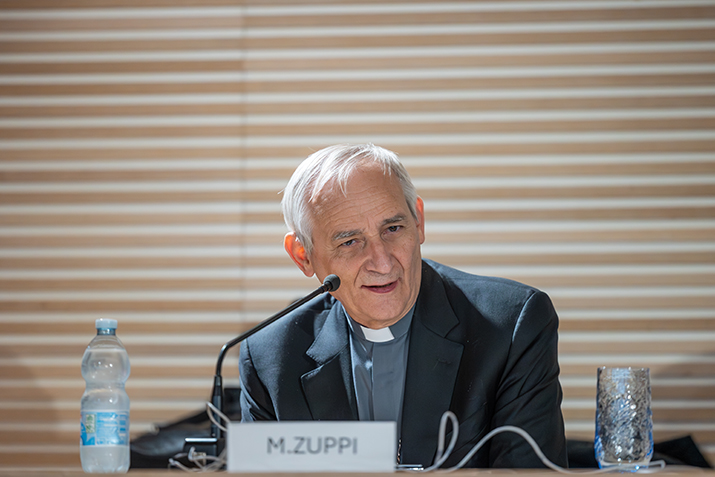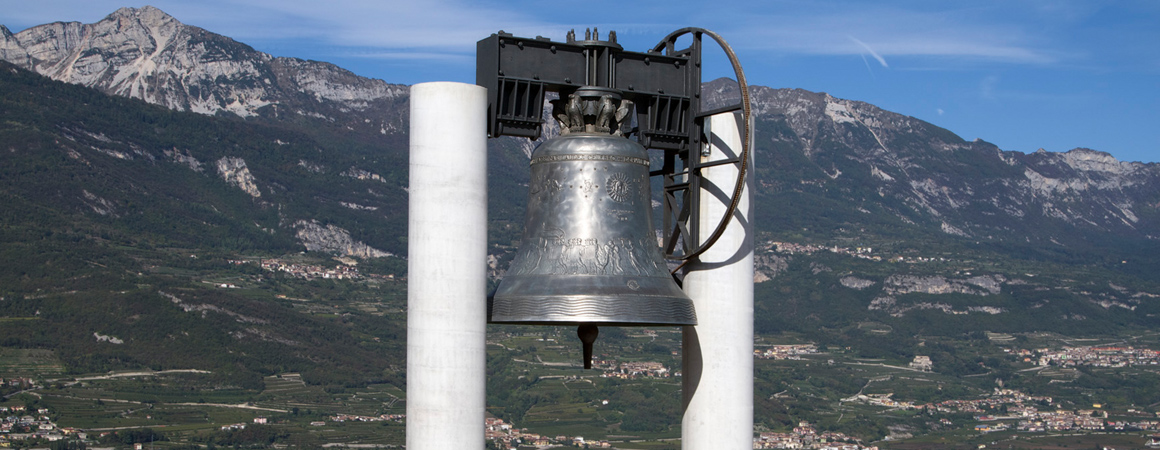

CARDINAL MATTEO ZUPPI AT THE BELL
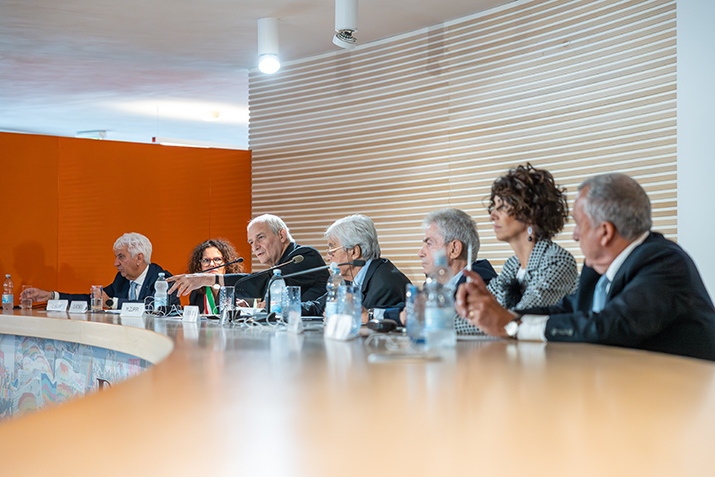
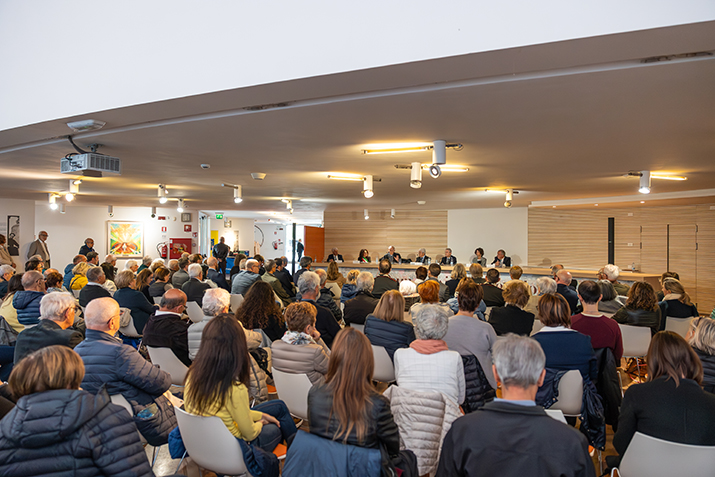
On 4 October, on the occasion of the centenary of the first chime of Maria Dolens, a 'Dialogue for Peace' took place in the Auditorium Alberto Robol between Cardinal Matteo Zuppi and the Honourable Mario Raffaelli, moderated by Gianni Bonvicini. Here below we will publish an excerpt from the cardinal's speech.
By transforming that which brings death into something that calls for life, the Campana dei Caduti of Rovereto still speaks to us. It is a signal that marks time, bringing the community together, and reminding us of the dignity and value of life. But not only that: the Bell is a great alarm clock. It not only calls us together, but also urges us forcefully: wake up! Wake up from the torpor, the resignation, the indifference that makes us forget the pain of others.
Today, on the centenary of its first tolling, the Bell rings in a world that seems to have learned nothing. Despite what happens, we struggle to understand. We never learn. So I ask myself - and I ask you - will we ever learn to live, as someone sang, 'without killing'? How many more cannonballs will it take for us to understand?
The answer is here, in this Bell. In this bronze that turned weapons into voice, death into memory, memory into commitment. Herein lies the meaning of our presence: not to celebrate a distant past, but to take responsibility in the present. The Bell is not a museum object, but a consciousness that calls to us.
A century ago, in 1925, this Bell rang for the first time, like a cry of love launched towards a wounded humanity. Today, when we see wars in so many parts of the world and a more fragile Peace than we had imagined, that gesture reminds us that Peace can never be taken for granted. Memory is fundamental, but it is not enough: it is not an end, it is a starting point.
Sixty years ago, in 1965, on 4 October, Paul VI spoke at the UN. The words he spoke were prophetic: 'No more war, ever'. He did so 'with the voice of all the fallen', as he put it. He had the courage to speak of Peace in a world that is still divided. That courage challenges us today, in a time that has so much need for prophecy and so little desire to listen.
The Church, by its very nature, is called to be a peacemaker.
Not a spectator, not a commentator, but an operator. All Christians are operators, or they should be. We do not always succeed—I know this all too well— but our vocation endures: to be builders of Peace.
Being peacemakers means being disarmed, because only those who are disarmed can truly disarm others. It is not enough to talk about Peace, you have to practice it in our daily lives. If we preach peace but continue to act aggressively, if we do not renounce violence - including the violence of words - then our voice becomes hollow. It becomes noise, rhetoric, sometimes even scandal. Peace is not only proclaimed: it is prepared, built, witnessed.
Repudiating war is an act of conscience. It is not a political or diplomatic formula: it is the conversion of the heart. Repudiating war means transforming memory into awareness. Borders remain, yet—as Paul VI reminded us—they no longer stand against others, no longer without others, but together.” Peace is not the absence of borders, but the ability to inhabit them with respect and trust.
War, any war, is always futile. Every conflict adds pain to the pain, and leaves scars that do not heal.
I recently listened to a daughter's account of her father, a World War I survivor, who witnessed the horror of gassings. And I met Ukrainian women looking for the bodies of their missing loved ones, who did not even have a place in which to mourn. In those faces I saw the true meaning of the Unknown Soldier: the suffering of those who do not even have a trace to remember.
The Bell is therefore a commitment. It is the voice of those who can no longer speak, but also the voice of those who must act. Every one of its chimes is a question: "And you, what do you do for Peace?" Maria Dolens transforms death into a call to life, tragedy into responsibility. It is a civil and spiritual sacrament at the same time.
Today we also celebrate St Francis, genius and poet of Peace. As a young man he had wanted to be a knight, and he achieved this, remaining a knight in white armour, a champion of courtesy, humanity and fraternity. In him we see the disarming face of an unarmed man. His encounter with the wolf of Gubbio is more than a legend: it is a Peace manual. Everyone else wanted to kill the wolf, yet St Francis called it 'brother'. He did not deny evil, he acknowledged it and sought the reason for its presence. He told the animal: "I know why you do it. You are hungry. If we feed you, will you stop?" And that is what happened.
St Francis did not eliminate the enemy, he reconciled it. He took away the cause of the evil. He taught Gubbio that Peace is not something that is imposed, it is built together. When the wolf died, everyone grieved for it: it had become part of the community. This is Peace. Not the absence of conflict, but its transformation. Not the illusion of a world without differences, but the ability to experience differences as brotherhood.
This is why I say that Peacemakers are the only true realists. It is easy to talk about 'Peace'. Peace is possible, it is not naivety, it is intelligence of the heart. Doing the groundwork to achieve Peace is the only way to avoid war. Paul VI said so, quoting Kennedy: 'Man will end war or war will end humanity'.
I'm afraid we have got worse. There is even a 'nuclear clock' that measures the number of seconds until the catastrophe strikes. But we do not really understand what the destruction of millions of people in a few moments means. Perhaps this is why the Bell is needed: it wakes us up. It reminds us that Peace is not a dream for beautiful souls, but something urgently required by real people.
The groundwork for Peace is done by removing the causes of hatred, by listening, reconciling. And this, believe me, is possible. Now, and always.